
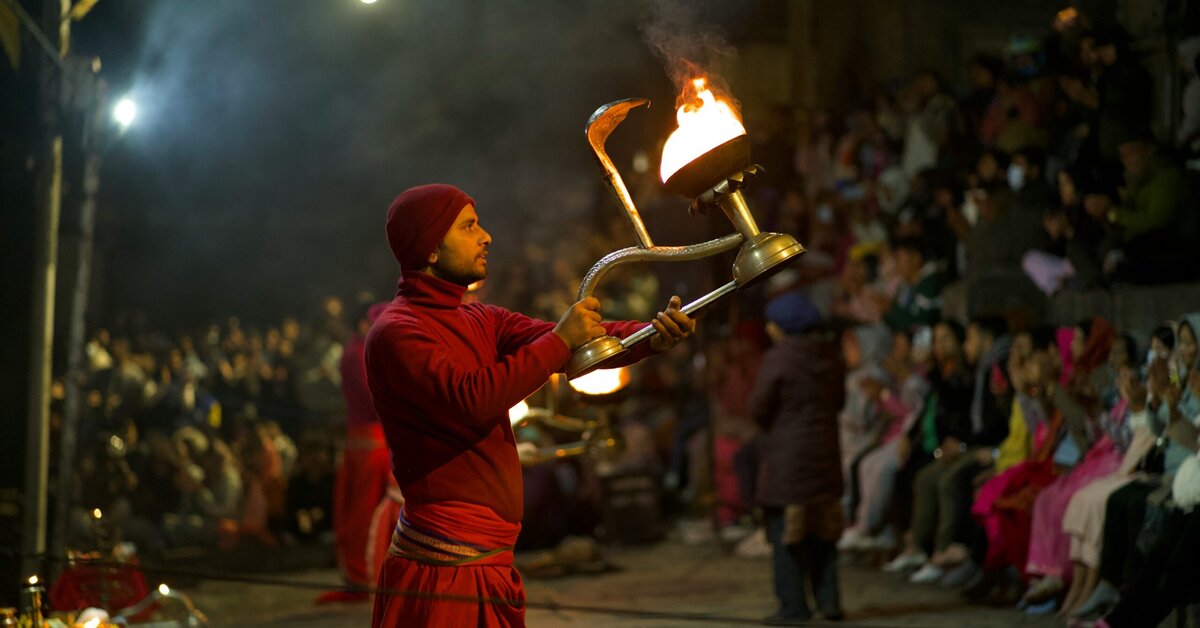
Ganga Aarti in Varanasi A Spiritual Experience , Have you ever witnessed a moment so profound that time seems to stop? Where thousands of strangers become united in devotion, where ancient flames dance against the darkening sky, and where a sacred river receives offerings that span millennia? This is the Ganga Aarti in Varanasi—a ceremony that transcends mere ritual to become a doorway into India’s spiritual heart.
Ganga Aarti is a worship ceremony performed twice daily on the banks of the holy Ganges River in Varanasi, offering reverence to the river goddess Ganga. But calling it simply a “ceremony” feels inadequate. It’s theater, prayer, meditation, celebration, and surrender all woven into one magnificent expression of devotion. For many visitors, attending the Ganga Aarti becomes the highlight of their Indian journey—a memory that continues to resonate long after they return home.
Varanasi, one of the world’s oldest living cities, provides the perfect setting for this sacred spectacle. Here, the Ganges isn’t just water—it’s Mother Ganga, the divine force that flows from the heavens through Shiva’s locks to purify the earth. The city’s ancient ghats, its temples crowding the skyline, and its 3,000-year history of continuous worship create an atmosphere where the spiritual and physical worlds meet. The Ganga Aarti embodies this meeting point, making visible the invisible threads of faith that have sustained this city through countless generations.
The Historical and Religious Significance of Ganga Aarti
Ancient Origins and Vedic Traditions
The practice of aarti—offering light to the divine—has roots stretching back thousands of years to Vedic times. Ancient texts describe fire rituals (yajnas) where flames carried prayers and offerings to the gods. The specific practice of river aarti evolved as water worship merged with fire rituals, creating ceremonies that honored both elements simultaneously.
While the exact origins of Ganga Aarti in its current form are debated, the practice gained prominence during the medieval period when bhakti (devotional) movements emphasized accessible worship that common people could participate in alongside priests. The evening aarti at Dashashwamedh Ghat in its present organized form is relatively recent—established in its current choreographed version in the last few decades—but it draws on centuries of tradition.
The Sacred Relationship Between Varanasi and the Ganges
Varanasi and the Ganges share an inseparable bond in Hindu mythology and practice. According to legend, this is where Lord Shiva stood when the Ganges descended from heaven, her force so powerful it could destroy the earth. Shiva caught her in his matted hair, slowing her descent and making the river safe for humanity.
The Ganges in Varanasi is believed to be especially purifying. A bath here washes away sins, and dying in Varanasi with Ganga water on one’s lips is considered the most auspicious death. The Ganga Aarti honors this sacred relationship—humans expressing gratitude to the divine mother who sustains life, purifies souls, and offers liberation.
Spiritual Meaning of Fire Worship
Fire (Agni) holds special significance in Hindu tradition as a mediator between earthly and divine realms. The flames of the aarti lamps symbolize the removal of darkness (ignorance) and the illumination of wisdom. Fire transforms whatever it touches, just as spiritual practice transforms the practitioner.
The circular motion of the lamps during aarti represents the cyclical nature of existence—birth, death, and rebirth—and the eternal presence of the divine throughout these cycles. By waving fire before the river, devotees acknowledge that the physical Ganges is a manifestation of the divine, worthy of the same worship offered to deity images in temples.
Understanding the Ritual Elements
The Five Elements (Panch Tatva) in Aarti
The Ganga Aarti beautifully incorporates the five elements (earth, water, fire, air, and space) that constitute existence according to Hindu philosophy:
Earth is represented by the ghat itself, the solid ground where humans stand to worship Water flows before us in the form of the sacred Ganges Fire blazes in the aarti lamps, purifying and illuminating Air carries the smoke, fragrance, and sound throughout the space Space (ether) is the consciousness that contains and witnesses everything
This integration of all five elements creates a holistic spiritual experience, engaging not just the mind but the entire being.
Symbolism of the Lamps and Flames
The massive brass lamps used in Ganga Aarti have five wicks arranged in tiers, creating a spectacular visual display. The five wicks represent the five elements, while their circular arrangement symbolizes completeness and infinity.
The flames themselves represent divine light—the inner light of consciousness that exists in all beings. By offering light to the divine, devotees acknowledge that all light originates from the source and returns to it. The reflection of flames on the water creates a doubled image, symbolizing the unity of heaven and earth, spirit and matter.
Sacred Chants and Mantras
The aarti is accompanied by specific Sanskrit chants and hymns, primarily:
“Om Jai Gange Mata”—a devotional song praising Mother Ganga Vedic mantras invoking Agni (fire) and various aspects of the divine Shiva mantras—since Varanasi is Shiva’s city and Ganga flows from his hair
Even if you don’t understand Sanskrit, the sound vibrations themselves are considered spiritually powerful. The rhythmic chanting creates a meditative state, allowing participants to transcend ordinary consciousness and enter a devotional space.
The Role of Bells and Music
The continuous ringing of bells serves multiple purposes. Practically, it helps synchronize the priests’ movements. Spiritually, bell sounds are believed to ward off negative energies and attract divine attention. The metallic reverberation creates an acoustic environment that seems to lift prayers upward.
Accompanying music—drums, cymbals, and sometimes harmoniums—provides rhythmic structure and emotional crescendo. The building intensity of sound mirrors the building spiritual energy as the ceremony progresses toward its climax.
Where to Experience Ganga Aarti in Varanasi
Dashashwamedh Ghat: The Grand Spectacle
Dashashwamedh Ghat hosts Varanasi’s most famous and elaborate Ganga Aarti. This ancient ghat—whose name means “ten horse sacrifices,” referring to a mythological yajna performed here by Lord Brahma—has been a center of worship for millennia.
The evening ceremony here is a grand production involving seven priests performing perfectly synchronized movements on raised platforms. The scale and choreography create a theatrical quality while maintaining genuine spiritual devotion. Thousands gather nightly—locals who’ve watched countless times and first-time visitors equally spellbound.
The ghat’s central location, wide steps allowing large crowds, and the impressive backdrop of temples and buildings make it the most dramatic setting. However, this popularity means significant crowds and a somewhat carnival atmosphere with vendors, photographers, and tourists mingling with genuine pilgrims.
Assi Ghat: The Intimate Morning Ceremony
Assi Ghat, located at the confluence of the Assi River and the Ganges, offers a different aarti experience. The morning ceremony here (around 5:30-6:00 AM) is smaller, more intimate, and attracts primarily devoted practitioners rather than tourists.
The setting is more peaceful—birds chirping, the rising sun painting the river gold, a slower rhythm allowing deeper absorption. Only one or two priests perform the ritual, but what it lacks in scale it gains in authenticity and tranquility. For those seeking spiritual depth over spectacle, Assi Ghat’s morning aarti is often more moving.
Other Notable Ghats for Aarti
Harishchandra Ghat and Manikarnika Ghat (the main cremation ghats) have their own evening aartis, smaller but profoundly philosophical. Witnessing aarti where cremations occur simultaneously creates powerful reflections on life, death, and the eternal.
Panchganga Ghat and Kedar Ghat also host evening ceremonies with smaller crowds and local devotees. These offer opportunities to experience aarti in a more traditional context without overwhelming tourism infrastructure.
The Evening Aarti at Dashashwamedh Ghat
Timing and Schedule
The evening aarti at Dashashwamedh Ghat begins around sunset, with timing varying by season:
Winter months (October-March): approximately 6:00-6:45 PM Summer months (April-September): approximately 7:00-7:45 PM
The ceremony lasts 45-60 minutes. Arriving 45 minutes to an hour early is advisable if you want a good viewing position, as crowds begin gathering well before start time. During peak tourist season (November-February) and during festivals, arrive even earlier.
The Seven Priests and Their Choreography
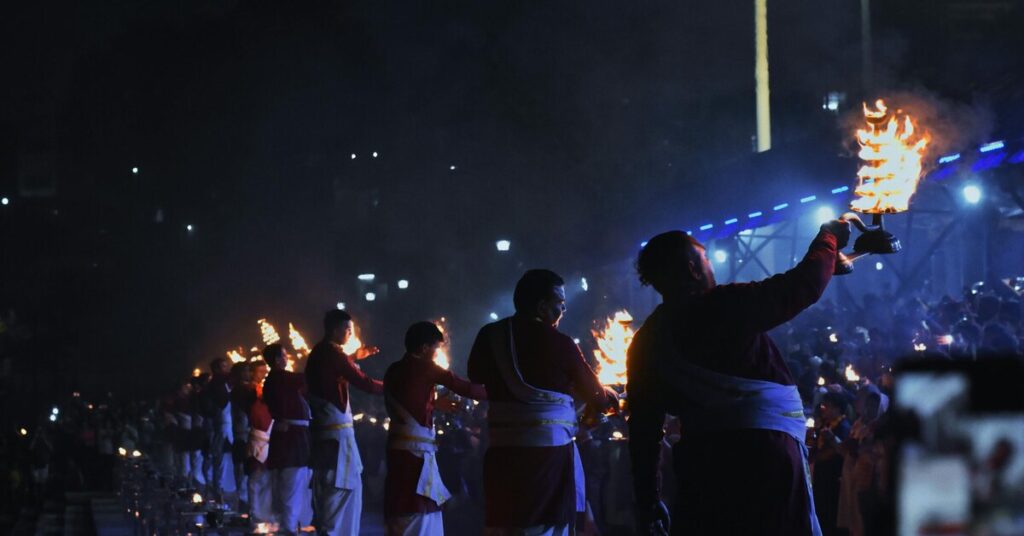
Seven priests, each in traditional attire of dhoti and silk stole, stand on raised concrete platforms arranged along the ghat. Each priest is positioned with precision, creating a visual line parallel to the river. They range in age from young men to elders, representing the continuity of tradition across generations.
The choreography is remarkably precise. All seven priests move in perfect synchronization—raising lamps, rotating them in circular patterns, lowering them, shifting to different implements—creating a mesmerizing visual rhythm. This coordination requires practice and concentration, as each priest wields heavy brass lamps (some weighing several kilograms) in elaborate patterns without missing a beat.
What Happens During the Ceremony
The aarti follows a structured sequence:
Opening invocations: Priests chant mantras while facing the river, establishing sacred space
Lamp offering: The main sequence involves multiple rounds of rotating large brass lamps with five wicks arranged in tiers. The priests wave these in elaborate circular patterns—clockwise and counterclockwise, high and low—creating arcs of flame against the darkening sky
Incense offering: Priests switch to large incense holders, waving fragrant smoke toward the river while maintaining rhythmic movements
Water offering: Using brass vessels, they sprinkle water toward the Ganges in blessing
Fan offering: Large yak-tail fans are waved in graceful arcs, symbolizing offering comfort to the divine
Final lamp offering: The ceremony concludes with another elaborate round of lamp waving, building to a crescendo
Closing prayers: Final mantras and blessings complete the ceremony
Throughout, devotional music plays, bells ring continuously, and the crowd’s energy builds from quiet anticipation to intense devotional fervor.
The Atmosphere and Energy
Describing the atmosphere at Ganga Aarti requires vocabulary beyond the ordinary. The air becomes thick with devotion—you can almost feel it pressing against your skin. The combination of visual spectacle (flames against twilight, reflected in moving water), sound (bells, chants, music, crowd murmurs), fragrance (incense, flower offerings, river water), and the sheer crush of humanity creates sensory overload that paradoxically induces a meditative state.
Many visitors—even skeptics—report feeling unexpectedly emotional. Tears flow without clear reason. The ceremony accesses something beyond rational understanding, touching a deep human need for connection with something larger than ourselves. Whether you interpret this as divine presence, collective unconscious, or simply the power of sustained cultural ritual, the effect is undeniable.
Morning Aarti: A Different Experience
Sunrise Ceremonies at Assi Ghat
The morning aarti at Assi Ghat creates an entirely different mood. As dawn breaks, the ceremony welcomes Surya (the sun god) and offers gratitude for the new day. The energy is fresh, hopeful, beginning rather than concluding.
Fewer tourists attend morning ceremonies, making them feel more authentic and participatory rather than performative. The smaller scale allows you to stand closer, hear the mantras more clearly, and feel less like a spectator and more like a participant.
The visual experience differs too. Where evening aarti features flames against darkness, morning aarti happens in gradually increasing natural light. The river appears different at dawn—calmer, clearer, more mirror-like. Birds provide natural soundtrack alongside the ritual bells and chants.
Peaceful Devotion vs Evening Grandeur
Choosing between evening and morning aarti depends on what you seek:
Evening aarti offers:
- Grand scale and choreographed precision
- Dramatic visual impact (flames against darkness)
- Intense crowd energy and collective devotion
- Better photography opportunities for flame shots
- More accessible timing for travelers
Morning aarti provides:
- Intimate, authentic atmosphere
- Peaceful contemplation
- Sunrise beauty and fresh energy
- Less crowded, easier participation
- A quieter spiritual experience
Many visitors try both, finding them complementary rather than redundant. The evening spectacle impresses and energizes; the morning ceremony soothes and centers.
How to Attend Ganga Aarti
Best Viewing Spots on the Ghat
Strategic positioning greatly affects your experience:
Front rows (closest to the platforms): Most intense experience, but extremely crowded, difficult to arrive early enough, and often blocked by people standing
Mid-level steps: Good balance of visibility and comfort, still close enough to feel the energy
Upper steps: Best for photography (elevated angle), more breathing room, but reduced sense of participation
Ghat edges: Less crowded but angled views, better for those uncomfortable in dense crowds
For evening aarti at Dashashwamedh Ghat, finding any spot with a clear view means arriving 30-60 minutes early. Bring something to sit on (the stone steps are hard) and be prepared to stay put—leaving and returning is nearly impossible once crowds gather.
Watching from a Boat: Pros and Cons
Viewing from a boat on the river offers unique advantages and disadvantages:
Pros:
- Unobstructed views without crowd crush
- Ability to see the entire ghat and all seven priests simultaneously
- Unique photographic angle with river foreground
- Can arrive right at start time rather than early
- Cooler and more comfortable than packed ghat steps
Cons:
- More distant from the action
- Reduced sense of participation and energy
- Cannot hear chants and bells as clearly
- Boat rocking makes photography challenging
- Feels more touristy and less authentic
- More expensive (boat rental fees)
Boat viewing works well for those with mobility issues, claustrophobia, or primarily interested in photography. Those seeking immersive spiritual experience typically prefer ghat viewing despite the discomfort.
Private Balcony Views
Some guesthouses and hotels on Dashashwamedh Ghat offer private balcony viewing—the most comfortable option. You watch from above, avoiding crowds entirely while enjoying clear views. Some establishments offer this as a paid experience (₹500-2000 per person) even for non-guests.
This option sacrifices participation for comfort and convenience. It’s ideal for elderly travelers, families with young children, or anyone for whom the physical challenges of ghat crowds are prohibitive. However, you miss the palpable energy and collective devotion that defines the experience for many.
Arriving Early and Securing Your Spot
For popular evening aarti at Dashashwamedh Ghat:
Peak season (November-February): Arrive 60-90 minutes early Festival times: Even earlier—2+ hours Off-season: 30-45 minutes is usually sufficient
Once positioned, stay put. The crowd becomes so dense that leaving means losing your spot permanently. Bring water, use restrooms beforehand, and prepare mentally for close quarters and long stillness.
For morning aarti at Assi Ghat, arriving 15-20 minutes early usually suffices, as crowds are much smaller.
What to Expect: A Sensory Journey
The Visual Spectacle
The visual impact of Ganga Aarti is extraordinary. As evening darkens, the massive brass lamps begin glowing—first one priest, then all seven in perfect synchronization. The flames create arcs of light, their patterns hypnotic and precisely executed. The reflection on the moving Ganges water doubles the effect, creating a shimmering, constantly shifting visual field.
Thousands of small diyas (earthen oil lamps) float downstream, released by devotees making offerings. These create rivers of light within the river itself—a galaxy of small flames drifting with the current, carrying prayers to the divine.
The backdrop adds depth—temple spires silhouetted against the twilight sky, old buildings with their weathered facades, crowds of people in colorful clothes creating a living mosaic, and the vast sky transitioning from blue to purple to black.
Sounds of Devotion
The acoustic landscape is equally rich. The ceremony begins with a resonant conch shell (shankh) blast, its ancient sound announcing the ritual’s commencement. Temple bells begin ringing—not random noise but rhythmic, coordinated ringing that creates a metallic soundscape.
Sanskrit chants, often amplified through speakers, fill the air. Even without understanding words, the phonetic patterns and tonal qualities induce altered states of consciousness. The crowd responds at certain points—”Om Jai Gange Mata” sung collectively, or calls of “Har Har Gange” that ripple through thousands of throats.
Drums provide rhythmic foundation—tabla or larger ceremonial drums beating patterns that accelerate as the ceremony builds. Cymbals crash at precise moments. Harmoniums sustain long notes beneath the chanting. The collective sound is orchestral, primitive, and deeply moving.
Scents and Sacred Atmosphere
The fragrance landscape constantly shifts. Incense smoke—thick, sweet, complex—wafts across the ghat, carrying prayers skyward. Fresh flowers (marigolds, roses, jasmine) used in offerings create layers of natural perfume. The river itself has a distinct smell—earthy, ancient, slightly metallic—that becomes oddly comforting as you spend time at the ghats.
Bodies pressed close in crowds add human warmth and scent. Sweat mingles with perfumes, oils, and natural body odors—not unpleasant but distinctly human, reminding you of the collective nature of the experience.
After aarti concludes, food vendors fire up their stalls—frying samosas, making chai, preparing sweet jalebis—adding cooking aromas to the aromatic tapestry.
Emotional and Spiritual Impact
The emotional response to Ganga Aarti varies individually but certain patterns emerge. Many report:
Unexpected tears: Even atheists find themselves crying without knowing why
Deep peace: Despite crowds and noise, an internal settling occurs
Connection: Feeling part of something larger than individual existence
Humility: Confronting how small your personal concerns seem against millennia of faith
Gratitude: For life, beauty, the ability to witness such devotion
Confusion: Not understanding but being moved regardless
Transformation: Sensing something shift internally—priorities reordering, perspectives widening
This isn’t universal—some remain unmoved or frustrated by crowds—but enough people report profound impact that the ceremony has become a pilgrimage in itself.
Participating in the Ceremony
Offering Diyas (Oil Lamps) to the Ganges
One of the most popular ways to participate actively is offering small leaf boats containing diyas and flowers to the Ganges. Vendors sell these throughout the ghat before and after aarti (₹20-100 depending on size and elaborateness).
The ritual is simple but meaningful:
- Purchase your diya arrangement
- Cup it carefully in both hands
- Make a personal prayer or wish
- Gently release it into the Ganges
- Watch it drift downstream, carrying your offering to the divine
Seeing hundreds of these small lights floating away creates a second visual spectacle after the main ceremony. Each tiny flame represents someone’s hope, gratitude, or prayer—a visible manifestation of invisible intentions.
Proper Etiquette and Behavior
Respecting the ceremony and fellow participants requires mindful behavior:
Do:
- Dress modestly (covered shoulders and knees)
- Remove shoes before stepping onto the ghat proper
- Sit or stand quietly during the ceremony
- Keep phones on silent
- Participate sincerely or observe respectfully
- Make space for genuine devotees to be closer
- Accept prasad if offered
- Show reverence even if not Hindu
Don’t:
- Talk loudly or make disruptive noise
- Push aggressively through crowds
- Stand in front of seated people unnecessarily
- Point feet toward the ritual or river
- Eat or smoke during the ceremony
- Touch ritual objects without permission
- Mock or laugh at devotional expressions
- Block others’ views with selfie sticks or excessive photography
Remember this is active worship for many present, not a performance staged for tourists. Treating it with appropriate gravity honors both the tradition and the faithful.
Photography Guidelines
Photography is generally allowed, but thoughtful photographers follow certain principles:
Technical tips:
- Use fast lenses (f/2.8 or wider) for low-light shooting
- Increase ISO as needed (3200-6400 range)
- Shoot in RAW for post-processing flexibility
- Bring tripod or monopod for stability
- Capture motion by using slower shutter speeds (flames create beautiful trails)
Ethical considerations:
- Don’t use flash—it’s disruptive and ruins the atmosphere
- Be mindful of people in your frame—some don’t want to be photographed
- Don’t obstruct others’ views with excessive equipment
- Focus on the ceremony, not just “getting the shot”
- Put the camera down periodically to simply experience rather than document
The best photographs often come from those who watch first, understand the ceremony’s flow, then shoot selectively rather than photographing frantically from start to finish.
The Deeper Spiritual Meaning
Aarti as Gratitude to the Divine Mother Ganga
At its core, Ganga Aarti is an act of thanksgiving. The Ganges provides life—water for drinking, crops, bathing, and transportation. Spiritually, she offers purification and liberation. The ceremony reciprocates these gifts through worship, acknowledging divine grace with devotional service.
This gratitude extends beyond individual benefits to cosmic appreciation. The aarti honors the mystery of existence itself—how consciousness manifests as water, as life, as the capacity to recognize and worship the divine. Each flame offered acknowledges: “I did not create myself. I am not self-sufficient. I depend on grace I can never fully repay.”
Connecting with Millennia of Tradition
Participating in Ganga Aarti connects you with an unbroken chain of practitioners stretching back thousands of years. Standing on those same stone steps, watching those same flames, chanting those same mantras creates temporal vertigo—past, present, and future collapsing into an eternal now.
Your ancestors (if Indian) or spiritual predecessors (if not) stood here offering similar prayers. Your descendants or future seekers will stand here long after you’re gone. This continuity provides profound comfort—individual life is brief, but something essential persists, handed carefully from generation to generation.
The tradition’s survival through millennia of change—empires rising and falling, technologies transforming human life, ideologies competing—testifies to something timeless it addresses in the human soul. Being part of that continuity, even briefly, anchors you in something more permanent than the constantly changing present.
Personal Transformation Through Witnessing
Witnessing Ganga Aarti can catalyze personal transformation in unexpected ways. The ceremony doesn’t demand specific beliefs but creates conditions where transformation becomes possible:
Perspective shift: Your daily concerns shrink when confronted with suchdevotion and the river’s eternal flow. What seemed urgent yesterday feels less so after watching centuries-old rituals unfold with patient precision.
Opening to mystery: Modern life emphasizes explanations and control. Ganga Aarti confronts you with something that can’t be fully explained or controlled—only experienced and allowed to work on you.
Recognition of devotion’s power: Whether or not you share the specific beliefs, witnessing genuine devotion demonstrates that faith and surrender have transformative power. This recognition can awaken dormant spiritual hunger.
Connection beyond words: The ceremony communicates through symbol, ritual, and collective energy rather than rational argument. This reminds you that the deepest truths often transcend language.
Many travelers report that Ganga Aarti became a turning point—the moment they stopped merely touring India and started truly encountering it. The ceremony serves as initiation into deeper layers of understanding.
Practical Tips for Visitors
Best Time to Visit
Season considerations:
Winter (November-February): Most comfortable weather, but largest crowds and highest prices. The clear evening skies create perfect conditions for the ceremony. However, expect to fight for viewing space.
Spring (March-April): Still pleasant, fewer crowds than peak winter. Good balance of weather and accessibility.
Monsoon (July-September): Smallest crowds, lowest prices, but humidity and rain can complicate viewing. The swollen, fast-flowing Ganges adds dramatic power. Bring rain protection and accept that weather might interfere.
Summer (May-June): Intense heat makes daytime uncomfortable, but evening aarti timing means cooler temperatures. Significantly fewer tourists create easier viewing experiences.
Day of the week: Weekends see more domestic tourists. Weekdays (Tuesday-Thursday) typically offer smaller crowds. Festival dates bring enormous crowds—check Hindu calendar if you prefer or want to avoid festival energy.
What to Wear
Clothing requirements:
- Modest coverage: Shoulders and knees covered out of respect
- Comfortable fabrics: Cotton or linen breathe better in crowds
- Layers for evening: Even in warm seasons, river breezes after sunset can be cool
- Light colors: Show respect and photograph better in low light
- Easily removed shoes: You’ll take them off frequently
Practical considerations:
- Secure pockets or small bag: Crowds create pickpocket opportunities
- Dupatta or shawl: Women can cover heads if desired; also useful as cushion on stone steps
- Comfortable footwear: You’ll walk on uneven ghats and steps
- Avoid expensive jewelry: Keep valuables minimal and secure
What not to wear:
- Revealing clothes (shorts, short skirts, tank tops)
- Expensive watches or jewelry
- White clothes if sitting on steps (they’ll get dirty)
- Leather items (some consider it disrespectful near sacred sites)
Staying Safe in Crowds
Large crowds require specific safety awareness:
Physical safety:
- Keep valuables in front pockets or secure bag
- Stay aware of surroundings and people too close
- Women should consider positioning near other women or families
- Establish meeting points if separated from your group
- Keep phone charged for emergencies
- Know your hotel name and location in local language
Health considerations:
- Stay hydrated but use restrooms before arrival
- Be cautious about food from questionable vendors
- Keep hand sanitizer accessible
- Protect against mosquitoes (especially near river at dusk)
- Watch your step—uneven stones can cause falls
Crowd psychology:
- Don’t fight the crowd flow—move with it
- If feeling claustrophobic, move toward edges rather than pushing through center
- Signal clearly if you need space or help
- Keep calm if jostled—it’s usually accidental in dense crowds
Dealing with Touts and Vendors
The ghats attract aggressive vendors and touts. Handle them skillfully:
Strategies that work:
- Firm but polite “no thank you” without stopping or engaging
- Pretend not to understand if they persist
- Ignore rather than argue (arguing encourages persistence)
- Decide what you want to buy beforehand and approach vendors rather than responding to pitches
- If hiring a boat, negotiate price clearly before boarding
Common approaches to expect:
- Offers to “guide” you (often leading to commission-based shop visits)
- Aggressive flower/diya vendors
- Photography services you didn’t request
- Boat operators promising “best views”
- Children selling trinkets or asking for donations
Scams to avoid:
- “Free” offers that become expensive
- Unofficial “priests” offering special blessings for large fees
- Claims that certain areas are restricted without a guide
- Inflated prices followed by “special discounts”
When to engage:
- If genuinely interested in what’s offered
- When prices seem reasonable and the vendor respectful
- For legitimate services (boat rental, diya purchase, photography)
The key is distinguishing between normal commerce and aggressive exploitation. Most vendors are simply trying to make a living; a few are deliberately predatory. Firmness without rudeness works best.
Beyond the Main Ceremony
Exploring the Ghats After Aarti
The ghats transform after aarti concludes. The immediate post-ceremony period has its own beauty:
Evening exploration (8:00-10:00 PM):
- The crowd disperses gradually, revealing the ghat’s architecture
- Small groups continue singing bhajans (devotional songs)
- Sadhus (holy men) gather at certain spots for philosophical discussions
- Tea stalls come alive with locals discussing the day
- The river reflects city lights, creating magical atmosphere
Late night atmosphere (10:00 PM-midnight):
- The ghats become remarkably quiet
- Serious spiritual seekers meditate in peaceful corners
- The city’s neon and traffic noise fade away
- Stars become visible as light pollution decreases
- Walking along the ghats feels like time travel to ancient Kashi
Early morning (4:00-6:00 AM):
- The ghats wake before the city
- Yoga practitioners gather for sunrise sessions
- Morning bathers perform religious ablutions
- Cremation ghats operate continuously (a profound sight)
- Sunrise boat rides offer the day’s most beautiful river views
Each time period offers different energy and insights. Spending an entire cycle (evening through next morning) at the ghats provides comprehensive understanding of their rhythms.
Temple Visits Nearby
Several significant temples are within walking distance of Dashashwamedh Ghat:
Kashi Vishwanath Temple (300 meters): The most sacred Shiva temple in Varanasi, recently renovated with an impressive corridor. Expect queues but the darshan is powerful. Security is strict—no phones, cameras, or bags allowed.
Annapurna Temple: Dedicated to the goddess of nourishment. Smaller, less crowded, with beautiful architecture and peaceful atmosphere.
Sankat Mochan Temple: About 3 kilometers south, dedicated to Hanuman. Famous for its resident monkeys and classical music festivals.
Durga Temple: Known as “Monkey Temple” for obvious reasons. The red-stone structure is architecturally interesting, though the aggressive monkeys require caution.
Visiting temples after attending aarti creates a more complete spiritual experience, transitioning from collective worship to personal devotion.
Local Food and Culture
The area around the ghats offers rich culinary experiences:
Must-try foods:
- Kachori-sabzi: Morning breakfast specialty—spiced kachori with potato curry
- Banarasi paan: Betel leaf preparation with sweet/savory fillings, a post-aarti tradition
- Lassi: Thick, creamy yogurt drink from famous shops like Blue Lassi
- Chaat: Various street snacks—aloo tikki, dahi vada, tamatar chaat
- Malaiyo: Winter delicacy—sweetened milk foam available only December-February
Dining locations:
- Street stalls: Most authentic but choose busy ones with high turnover
- Kashi Chat Bhandar: Famous chaat spot near Dashashwamedh
- Deena Chat Bhandar: Another legendary chaat destination
- Hotel/guesthouse restaurants: Safer for sensitive stomachs
Cultural experiences:
- Silk shopping: Varanasi is famous for Banarasi silk sarees and brocades
- Classical music performances: Some venues host nightly concerts
- Walking tours: Guided walks through narrow lanes revealing hidden temples and stories
- Traditional workshops: Watching weavers, brassworkers, or flower garland makers
The ghat area is a complete cultural ecosystem. The more time you spend exploring beyond the main aarti, the richer your understanding becomes.
Comparison with Other River Aartis in India
Haridwar’s Har Ki Pauri Aarti
Haridwar, where the Ganges enters the plains from the Himalayas, hosts another famous Ganga Aarti at Har Ki Pauri ghat. Comparisons with Varanasi:
Similarities:
- Both honor the Ganges with fire offerings
- Large crowds and devotional atmosphere
- Evening timing and similar ritual structure
- Floating diyas on the river
Differences:
- Haridwar’s aarti is less choreographed, more spontaneous
- Smaller scale with fewer priests
- Mountain backdrop creates different visual atmosphere
- Colder climate and clearer water
- Less tourist infrastructure, more pilgrim-focused
- Simpler, more traditional feel
Haridwar feels more purely devotional, while Varanasi has evolved into a spectacle that’s both authentic worship and tourist attraction.
Rishikesh’s Parmarth Niketan Aarti
The aarti at Parmarth Niketan Ashram in Rishikesh offers yet another variation:
Distinctive features:
- Performed by ashram residents and students
- More meditative, less theatrical
- Includes spiritual discourse and singing
- International participants create multicultural atmosphere
- Smaller, more intimate setting
- Focus on yoga and spiritual education alongside ritual
Rishikesh’s aarti attracts spiritual seekers more than conventional tourists. The emphasis is on participation and understanding rather than spectacle.
What Makes Varanasi Unique
Varanasi’s Ganga Aarti stands apart for several reasons:
Historical weight: Varanasi’s 3,000+ year history as spiritual center creates unmatched gravitas
Scale and coordination: The seven-priest synchronized ceremony is unparalleled in complexity
Cultural significance: This is where Hindu cosmology places Shiva’s eternal residence
Death and rebirth: The presence of cremation ghats adds philosophical depth
Tourist infrastructure: Well-developed systems for visitors, though this cuts both ways
Photogenic power: The visual spectacle is unmatched—more dramatic and varied
Intensity: The sheer concentration of devotional energy in one place
If you can visit only one Ganga Aarti, Varanasi offers the most comprehensive, powerful, and memorable experience, despite (or perhaps because of) its complexity and challenges.
Capturing the Experience
Photography Tips
Creating memorable photographs of Ganga Aarti requires technical skill and artistic vision:
Camera settings:
- ISO: 3200-6400 (embrace grain for atmosphere)
- Aperture: f/2.8 or wider if possible (f/1.8 is ideal)
- Shutter speed: 1/60s-1/125s for frozen action; 1/15s-1/30s for flame trails
- White balance: Tungsten or custom setting (auto will struggle)
- RAW format: Essential for post-processing flexibility
Compositional strategies:
- The priests: Capture synchronized moments when all seven align
- Flame reflections: Position to catch water reflections
- Crowd devotion: Close-ups of faces showing emotion
- Wide establishing shots: Showing entire scene’s scale
- Details: Individual lamps, hands in prayer, floating diyas
- Silhouettes: Backlit figures against flames
- Long exposures: Turning flames into light paintings
Timing:
- Scout location before ceremony for best angles
- Shoot throughout—beginning, middle, and end all offer different opportunities
- The post-ceremony diya floating is often more photogenic than the ceremony itself
- Blue hour (just after sunset) provides beautiful ambient light mixing with flames
Equipment recommendations:
- Fast prime lens (35mm f/1.8 or 50mm f/1.8 minimum)
- Monopod for stability in crowds (tripods too cumbersome)
- Extra batteries (cold and continuous shooting drain them)
- Lens cloth (incense smoke creates haze on front element)
Video Recording Considerations
Video captures atmosphere that still photos miss—the sound, movement, and temporal flow:
Technical approach:
- Stabilization is critical (gimbal, tripod, or good handheld technique)
- Record in 4K for cropping flexibility
- Capture establishing wide shots and detailed close-ups
- Record ambient sound separately if possible (ceremony audio plus environment)
- Plan for low light (f/2.8 minimum, high ISO capability)
Ethical filming:
- Don’t let documentation prevent presence
- Be especially mindful of blocking others’ views with video equipment
- Consider recording shorter segments rather than entire ceremony
- Capture the before and after atmosphere, not just the main ritual
Preserving Memories Respectfully
The best approach balances documentation with presence:
Strategies for mindful capture:
- Watch the ceremony once without camera to understand it
- On subsequent viewings (or if only one opportunity), shoot selectively
- Put camera down for the most powerful moments
- Journal immediately after to capture emotions and insights
- Create space between experiencing and processing/sharing
Sharing considerations:
- Be thoughtful about social media posting—this is sacred to many
- Avoid trivializing captions or inappropriate filters
- Provide context about the ceremony’s significance
- Consider whether sharing respects the experience or exploits it
- Ask yourself: am I sharing to inform/inspire or to gain validation?
The photographs you don’t take—the moments you simply witness—often become the most vivid memories. Cameras are tools for preserving, but presence is what creates experiences worth preserving.
Spiritual Reflections from Travelers
Emma from Australia: “I’m not religious at all, raised completely secular. But standing at Dashashwamedh Ghat, watching those flames and feeling that collective devotion—something broke open in me. I cried for reasons I still can’t articulate. It wasn’t conversion to Hinduism; it was recognition that something sacred exists, whatever you call it. That night changed my relationship with spirituality permanently.”
Ravi from Mumbai: “I’ve attended Ganga Aarti probably fifty times—I bring every visiting friend. It never gets old. Each time I notice something new: an elderly woman’s face during prayer, a child’s wonder at the flames, a foreign tourist unexpectedly moved to tears. The ceremony is the same, but my perception deepens. It’s like looking at a diamond—the gem doesn’t change, but each angle reveals new brilliance.”
Sarah from New York: “The crowds initially annoyed me—too touristy, too commercial. But then I realized: these ‘problems’ are symptoms of something working. People come because the ceremony genuinely moves them. The vendors sell because pilgrims need supplies for offerings. The ‘chaos’ is actually complex social ecology around genuine spiritual practice. Once I accepted that, I could see the sacred through the mundane.”
Amit from Delhi: “As a Hindu, I’d studied the Ganges’ mythology intellectually. But experiencing the aarti viscerally—that’s different. Watching my grandmother place her diya on the water, tears streaming down her face, praying for our family… I understood that this isn’t superstition or outdated ritual. It’s how humans have always processed mysteries too large for words: through symbol, community, and sacred action.”
Michael from Germany: “The most profound moment came after the aarti ended. I stayed sitting while crowds dispersed. A sadhu approached and simply sat beside me, saying nothing. We sat together maybe twenty minutes in comfortable silence, watching the river. No words, no transaction, just shared presence. That taught me more about spirituality than any ceremony could.”
Planning Your Visit to Varanasi
Getting there:
- By air: Lal Bahadur Shastri International Airport (25km from city center)
- By train: Varanasi Junction or Varanasi Cantt stations (both well-connected)
- By road: National highways connect to major cities, though long distances
Accommodation options:
- Budget: Hostels and guesthouses (₹300-800/night)
- Mid-range: Hotels near ghats (₹1,500-4,000/night)
- Luxury: Heritage properties with river views (₹6,000-20,000/night)
- Ashrams/Dharamshalas: Donation-based or nominal fees
Duration recommendations:
- Minimum: 2 nights to attend evening and morning aarti plus basic sightseeing
- Recommended: 3-4 nights for deeper exploration without rushing
- Ideal: 5-7 nights to truly absorb the city’s rhythms and visit surrounding sites
Combining with other destinations:
- Sarnath (10km): Buddhist pilgrimage site, half-day trip
- Ayodhya (200km): Ram Janmabhoomi, full-day or overnight trip
- Allahabad/Prayagraj (125km): Sangam (three-river confluence)
- Bodhgaya (250km): Where Buddha attained enlightenment
Health preparations:
- Vaccinations current (consult travel clinic)
- Stomach medications for potential food adjustments
- Hand sanitizer and water purification
- Modest first-aid kit
- Travel insurance covering medical emergencies
Mental preparation:
- Research basic Hinduism concepts for context
- Adjust expectations about comfort and efficiency
- Prepare for sensory intensity and cultural differences
- Open yourself to experiences that may challenge assumptions
- Remember that discomfort often accompanies transformation
Conclusion
The Ganga Aarti in Varanasi is more than a tourist attraction or even a religious ceremony—it’s a portal into something timeless and essential about human spirituality. Every evening, as flames are lifted toward the darkening sky and thousands of voices unite in ancient chants, the distance between past and present, sacred and mundane, self and other dissolves momentarily.
You don’t need to be Hindu to be moved by the aarti. You don’t need to understand every Sanskrit word or believe every mythological story. What matters is showing up with openness and respect, allowing the experience to work on you in whatever way it will. Some people find God; others find beauty; still others simply find a moment of peace in a chaotic world. All these discoveries are valid.
The ceremony demonstrates something our modern world sometimes forgets: that ritual, devotion, and collective worship serve profound human needs. They create space for experiences that transcend everyday consciousness. They connect individuals to lineages spanning millennia. They transform ordinary actions—waving fire, ringing bells, floating lamps—into bridges between worlds.
If you visit Varanasi, make time for the Ganga Aarti. Arrive early, find your spot, and when the conch shell announces the ceremony’s beginning, let yourself be present. Put down your camera occasionally. Feel the stone beneath you, the press of humanity around you, the river breeze on your face. Listen deeply. Watch closely. Let it touch you.
You may leave changed in ways you can’t immediately articulate. The flames’ after-image might linger behind your eyes. The chants might echo in your mind days later. And perhaps, in some quiet moment back home, you’ll remember standing on those ancient ghats, watching devotion flow like the eternal river, and you’ll understand something new about what it means to be human.
FAQs
1. What is the best time to attend Ganga Aarti in Varanasi?
The evening aarti at Dashashwamedh Ghat begins around 6:00-7:00 PM depending on sunset time, running year-round regardless of weather. For the best experience, visit during winter months (November-February) when weather is comfortable, though expect larger crowds. The ceremony occurs daily, so any day works, but weekdays have smaller crowds than weekends. Arrive 45-60 minutes early for good viewing positions. Morning aarti at Assi Ghat (around 5:30-6:00 AM) offers a more intimate, peaceful alternative with fewer tourists.
2. How long does the Ganga Aarti ceremony last?
The main evening aarti ceremony lasts approximately 45-60 minutes from opening invocations to closing prayers. However, plan for 2-3 hours total including: arriving early to secure viewing position (30-60 minutes before start), the ceremony itself (45-60 minutes), and post-ceremony activities like offering diyas to the river or exploring the ghat area (30-45 minutes). The experience is richer when not rushed, so allocating adequate time enhances the spiritual and cultural value rather than arriving at the last minute and leaving immediately after.
3. Is there an entry fee to watch Ganga Aarti?
No, there is no entry fee to watch Ganga Aarti from the ghat steps—it’s completely free and open to everyone regardless of religion or nationality. However, several optional paid elements exist: boat rentals for river viewing (₹200-500 per person), private balcony viewing at guesthouses (₹500-2,000), purchasing diyas to float on the river (₹20-100), donations for special seating areas maintained by organizations, and tips for photographers or guides. The ceremony itself and ghat access remain free, making it accessible to all economic levels.
4. Can non-Hindus attend and participate in Ganga Aarti?
Absolutely. Ganga Aarti welcomes people of all faiths and backgrounds. You’ll see Hindus, Buddhists, Muslims, Christians, atheists, and spiritual seekers from every tradition attending respectfully. Non-Hindus can observe from the ghat, watch from boats, purchase and float diyas, and experience the ceremony fully. The only requirement is showing appropriate respect—modest dress, quiet behavior during the ceremony, and sincere appreciation for the sacred nature of the ritual. Many non-Hindus report being deeply moved despite not sharing the specific religious beliefs, as the collective devotion and beauty transcend particular faiths.
5. What should I wear and bring to Ganga Aarti?
Wear modest, comfortable clothing covering shoulders and knees out of respect for the sacred setting. Light, breathable fabrics work best as crowds generate heat despite evening coolness. Bring easily removable shoes (you may need to take them off), something to sit on (stone steps are hard), water, hand sanitizer, and a small bag with secure closures. A shawl serves multiple purposes—covering shoulders, sitting cushion, or warmth if evenings are cool. Don’t bring expensive jewelry or large amounts of cash. Leave large bags at your hotel as crowds make them cumbersome. A camera or phone for photos is fine, but remember to put it down occasionally to simply experience the ceremony.



Comments are closed.